Watch
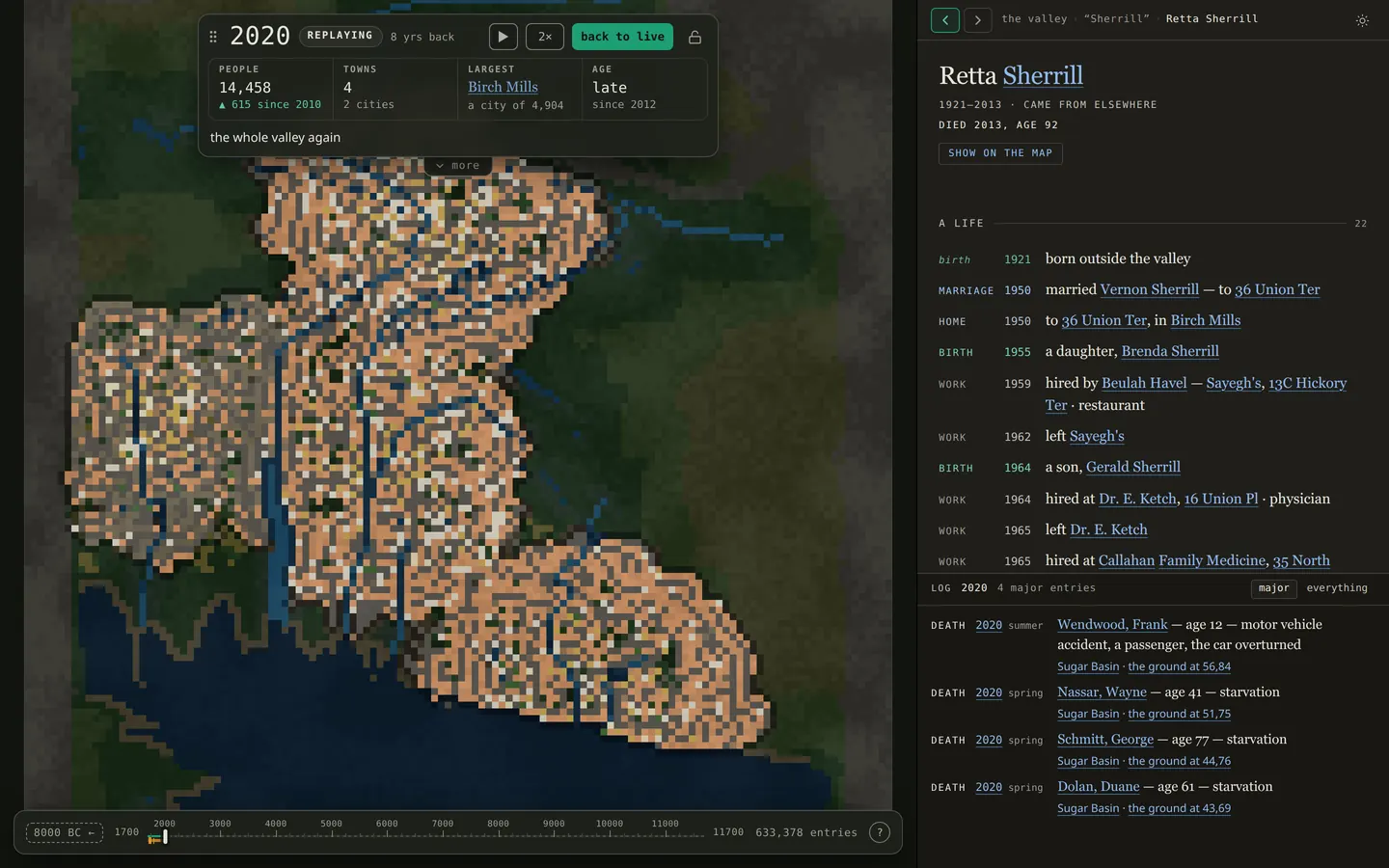
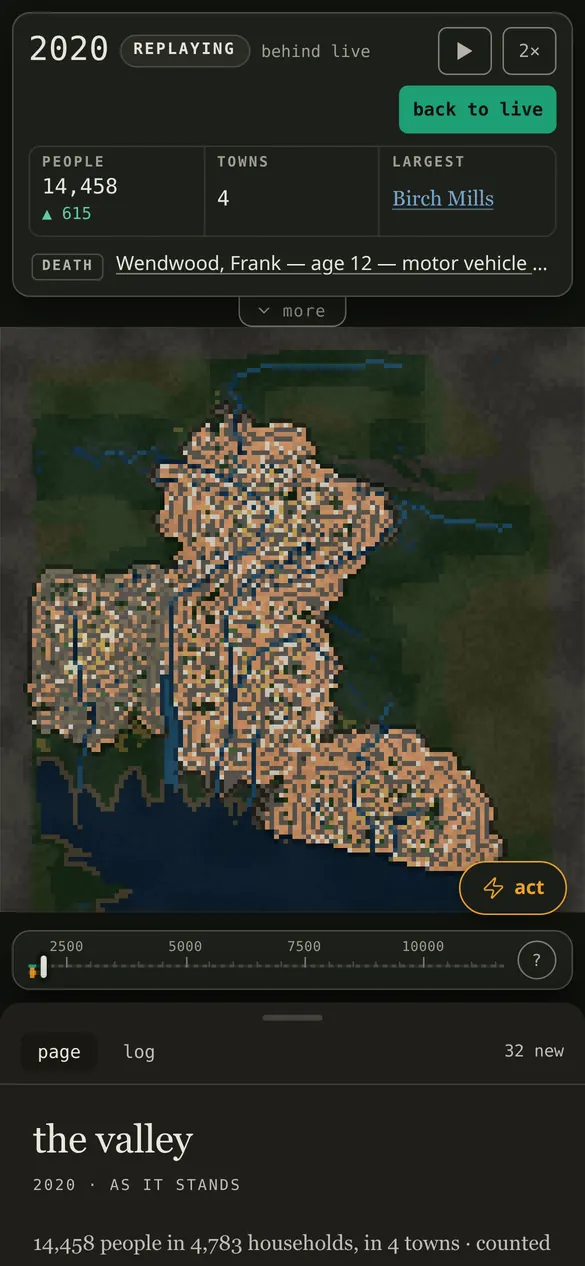
The map is an instrument. Farms clear, streets join up and towns grow toward each other. Scrub back through any year you've already watched.
A history game
One river valley. Ten thousand years. Every life lived there, written down.
A small party arrives in 1700 with a year's food and claims a mill site. From there the valley runs on its own. You watch, you read what its people wrote down, and once in a while you step in.
Ask for an invitation Read the record
It's an ant farm for history. There's no score and no way to lose. You're closer to the weather than to the mayor.
Year
Every frame is the game's own. Arrow keys move one year.
The map is an instrument. Farms clear, streets join up and towns grow toward each other. Scrub back through any year you've already watched.
Every name is a page. Every person, family, street and building has one, written in the records of its own time.
Your hand is small. A lightning strike, a new spring, a canal, a drained marsh. Then watch what a few centuries make of it.
Click the ground to read it. The record is kept in the documents of each era: church records and deeds early on, census returns and directories later, permits and payrolls after that. Nothing below was written for this page. The game wrote it.
The valley in 2020. Five lots are marked. In the game, every one of its 16,384 tiles opens.
No lot open yet.
Pick one of the five marked lots on the map, or start where the valley did.
One page of thousands. Nobody wrote her. The game did, and kept everything.
Every rate in the valley comes from how people actually lived, year by year. When the record settles a question, the game follows it.
Nothing is hidden to keep it pleasant. People die, a mill closes and its workers move on, a fire takes a street. The game writes it down the way a clerk would: a name, an age and a cause.
Your hand is small, and that's the point. Lightning is the only act that harms. The other three don't build anything. They change what the ground can offer, and the people decide whether to use it.
Call it down anywhere. A tree may fall, or a fire start.
Open one in a wet hillside.
Cut a reach of river navigable.
Shown below
Turn a marsh into ground someone might farm.
Year
as it was
New Landingport has stood 118 years, and its nearest water a boat can use is more than three kilometers off. You have one act in your hand: a canal cut.
97 reaches will take a cut. The map has dimmed everything else, as it does in the game.
In the game you choose any lit reach. This page carries one real cut, replayed in the game: the reach at 77,101, beside New Landingport.
Those are the game's own lines. Both futures ran to 2020 from the same valley, and everything before 1850 is identical. The map marks the ground that ended differently, not what the cut caused: one changed spring reshuffles everything after it.
Yearfall runs in your browser, with nothing to install. One sitting is a stretch of history, and coming back to it later is the whole idea.
Scrub through every year you've watched, at any speed.
On the night page, or on light paper.
The map takes the screen and the page pulls up over it.
As a link or a small file. It opens the same, entry for entry, in any browser.
A seed makes a valley, and the same seed always makes the same one. This page is seed 0x8f3a.
Yearfall is in testing, and invitations go out by hand. If a game you mostly watch sounds like your kind of thing, send me a message and I'll get you in.
Justin Zagar